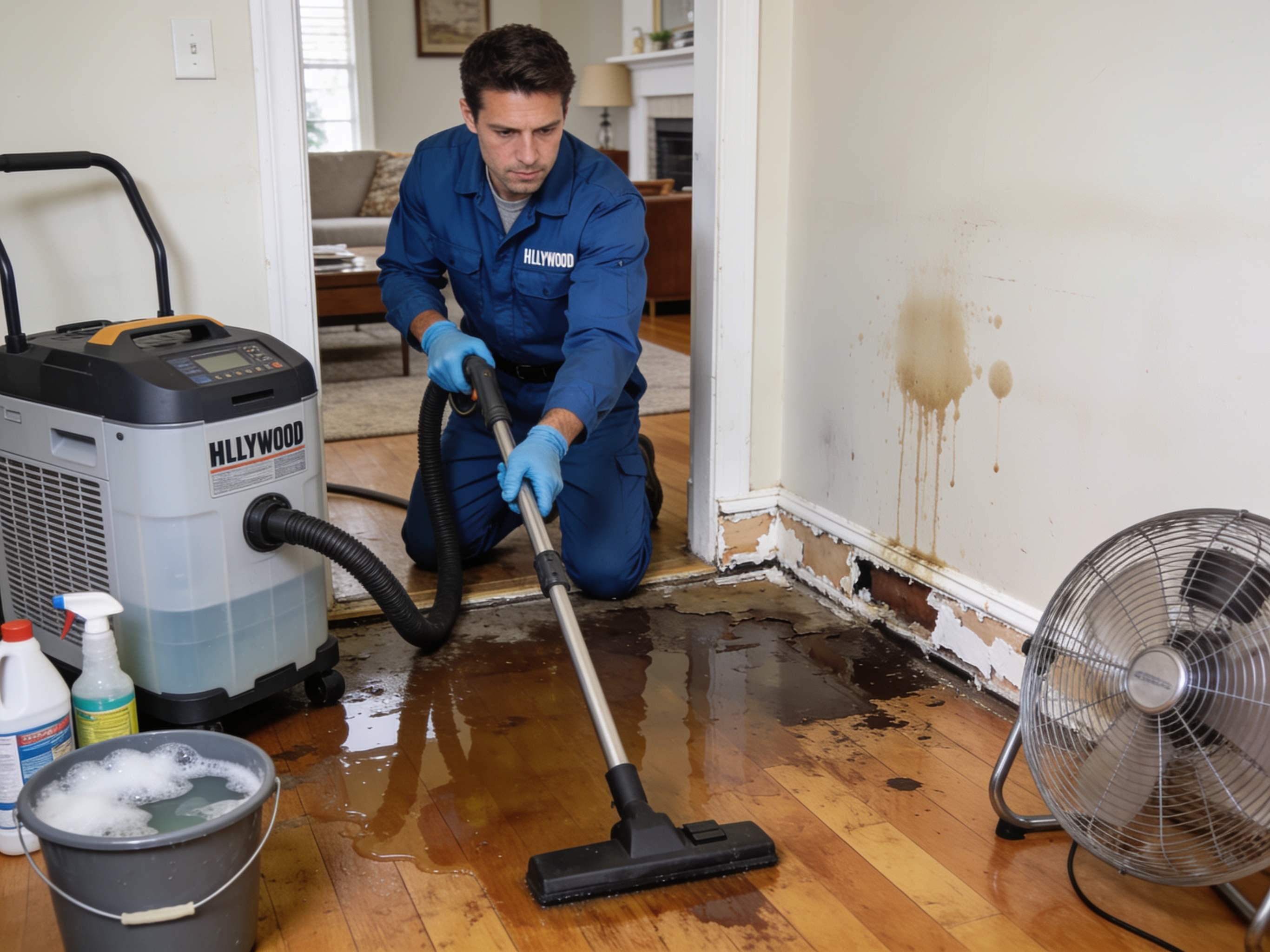
What Water Damage Restoration Is
Water damage restoration is the full sequence that returns a water-damaged property to a dry, sound, usable condition. It starts by stopping the source of the water and ends when the building, its finishes and its contents are back in working order. The sequence covers source control, water removal and extraction, structural drying, removal of material that cannot be saved, and restoration of what was damaged.
The aim is a property that is dry, sound and usable, not one that only looks dry. Dryness is shown by moisture readings, and usability by whether the finishes and contents are back in working order. Each of these depends on the stages that come before it.
On this site, leak detection, storm damage restoration, water removal and water extraction are not separate businesses. They are stages and specialisations of the same restoration service. A hidden supply leak needs leak detection before drying can start. Rain or tidal water that enters a home needs storm damage restoration, which follows the same core steps with added attention to contamination and debris. Water removal and water extraction describe the stage where water leaves the property. Each one is explained in full below.
Early stabilisation is often called water mitigation, and the work that rebuilds the damaged areas is called restoration. Both belong to one continuous job, because the first steps decide how much material can be saved later.
Hollywood properties take water from several common causes:
- plumbing failures, such as a burst supply line or a blocked drain
- appliance failures, such as a washing machine hose, dishwasher or water heater
- roof and window leaks that let rain into ceilings and walls
- heavy-rain intrusion, when water rises faster than the ground and drains can take it away
- tidal and storm flooding, including water pushed into buildings during king tides and large storms
Each cause leaves a different pattern of damage, but the restoration sequence is the same. Water that is not removed, and moisture that is not dried, keeps moving into building materials. That is why the process starts at the source and does not stop at the visible puddle. Storm and tidal water is handled with particular care, because it can carry dirt, debris, sewage or other contaminants from outside. The visible wet area is rarely the whole picture, because moisture spreads into the spaces behind walls and under flooring, where it can keep working on materials.
This page serves Hollywood homeowners, condo unit owners, landlords and tenants who have permission from the property owner to arrange work. If water is in your Hollywood property now, call (954) 707-5047.
When You Need It
You need water damage restoration when water has entered a property and building materials are still wet, or when the source of the water is not yet known. Waiting to see whether the damage gets worse lets water keep moving into materials. Water does not stay where it lands. It moves along floors, through seams and into the spaces behind walls and under flooring.
Watch for these signs:
- standing water on floors, from a leak, a storm or a tidal event
- soaked carpet, flooring, drywall or ceiling material
- stains that are spreading, bubbling paint, or a ceiling that sags
- the sound of running water inside a wall when no tap is open
- a water meter that keeps moving when every fixture is turned off
- water inside the property after heavy rain, a storm or a king tide
Hollywood's heavy rain and king tides make the last sign common. On April 12, 2023, 25.91 inches of rain were recorded at the Fort Lauderdale-Hollywood International Airport gauge. Hollywood received in excess of 15 inches in the same event. Water from a storm like that reaches buildings through roofs, windows, doors and the ground at the same time.
Musty odour after a known leak is another signal. It can mean that mold is already developing in damp materials. Mold remediation is a separate service, covered on the Mold Remediation page. Treat the smell as a sign to get the moisture source checked, not as something to cover up.
The reason to act early is practical, not a timer. Water moves downward and sideways into materials. Porous materials such as drywall, insulation, wood and flooring keep absorbing water while they stay wet. They swell, lose strength and hold moisture for as long as water and humidity remain. Secondary damage, such as warped subfloors, damaged cabinets and damp wall cavities, grows while the moisture stays in place.
South Florida humidity adds to the problem. Damp air slows evaporation, so wet materials take longer to dry without active equipment. Acting early generally leaves fewer materials to remove and fewer areas to dry.
How the Work Runs
Restoration runs in six stages, each one built on the last. The early steps decide how much material can be saved, so the work moves in order from the first call to final close-out, and the owner sees the scope before work proceeds.
1. Call and Assessment
The process starts with a phone call to (954) 707-5047. Describe what you see, where the water appears to have come from, and whether water is still entering the property.
On site, the source and extent of the damage are assessed. The affected areas are documented with photographs as found, before anything is moved, cleaned or removed. This record matters later. The City of Hollywood's permit route for damaged buildings in flood hazard areas asks for current photographs and a cost estimate, so good documentation from the first visit saves time (see Section 5).
2. Source Control and Leak Detection
Active water has to stop first. That may mean shutting off a supply line, isolating an appliance or covering an opening so rain cannot keep entering.
Where the source is hidden, the team uses moisture mapping with moisture meters to find the wet areas before anything is opened. Readings are taken across walls, floors and ceilings so the spread of moisture is clear. Openings are made where the evidence points, not by guesswork.
3. Water Removal and Water Extraction
Standing water is removed with extraction equipment. In practice, water removal and water extraction are the same stage named two ways. Removal is the everyday term for getting standing water out of a property. Extraction is the technical term for the equipment-driven work of pulling water out of carpet, pad, subfloor and hard surfaces. Because the two terms describe one stage on this site, both are answered on this page.
4. Structural Drying
Dehumidifiers and air movers are placed to pull moisture from the air and from building materials. Moisture readings are retaken as drying proceeds, and equipment is moved or adjusted where readings do not fall. Drying is measured, not assumed. It is complete when the readings show that the materials have returned to dry values.
5. Damaged Material Removal and Restoration
Material that cannot be dried, such as soaked drywall, wet insulation, some flooring and sections of subfloor, is removed. The affected areas are then restored.
Where flood rules apply, this is the stage where the paperwork reality is raised with the owner early. Under the City of Hollywood's substantial damage rule, repair costs at or above 50% of a structure's market value change the repair plan. Owners should know early whether that threshold applies, before the scope of work is settled.
6. Close-Out
Final moisture readings confirm that the property is dry. The documentation, including photographs, moisture readings and scope records, is handed to the property owner for their records.
What's Inside This Service
This service brings four connected parts together: water removal and extraction, structural drying, water leak detection and storm damage restoration. Each part is explained below, and each one connects to the core restoration sequence described in Section 1 of this page.
Water Removal and Extraction
Water removal and extraction is the stage where standing and absorbed water leaves the property. It is needed when water pools on floors, soaks carpet or pad, or sits in low areas after a storm or flood. In Hollywood, some neighbourhoods have seen up to 18 inches of water in recent flooding.
Extraction uses equipment in two broad classes. Truck-mounted extractors are powerful units, usually positioned outside, that run a long hose into the building. They suit large open areas and heavy carpet loads. Portable extractors are smaller machines carried inside. They suit tight spaces, stairs and smaller rooms. Which class applies depends on how much water there is, the floor types and how the building is laid out. The scale of the job is driven by the volume of water, how long it stood and how many rooms are affected.
Structural Drying and Dehumidification
Structural drying brings wet building materials back to a dry, stable condition. Technicians use moisture meters and moisture mapping to find where water has travelled, including inside wall cavities and beneath flooring systems.
Dehumidifiers pull moisture out of the air, and air movers push air across wet surfaces so moisture can evaporate. Wall cavities may be opened or drilled where needed so air can reach them, and flooring is lifted where water has collected underneath. South Florida's humid air makes this an active process. Opening windows does little to remove moisture from materials when the outside air is damp too. Drying time depends on the materials involved, how deeply moisture has travelled and the humidity conditions in the building. Drying is complete when readings show dry values, not when a surface merely looks dry.
Water Leak Detection
Water leak detection finds supply and drain leaks that are not visible. Common signs include an unexplained rise in the water bill, a damp patch with no obvious source, the sound of running water inside a wall, or a water meter that moves when fixtures are closed. In Hollywood, a wet wall may trace to a plumbing leak, or to rain and tidal intrusion.
The work starts with a visual check and listening, then moves to meters and moisture evidence. Moisture mapping shows where water has spread, which points toward the likely source. The team opens the smallest area needed to confirm the source, rather than demolishing walls and floors by guesswork. How hidden the leak is, how many areas must be opened and how much material is affected all shape the scope of this work.
Storm Damage Restoration
Storm damage restoration covers water that enters a property through rain, wind-driven rain, or tidal and flood intrusion. It differs from a plumbing event in several ways. Water from a clean supply line is handled differently from storm or floodwater, which can carry dirt, debris, sewage or other contaminants from outside. Materials are assessed for contamination before cleaning decisions are made.
Storm events also leave debris, such as sand, leaves and damaged exterior material, that must be cleared. Where flood rules apply, the permit dimension adds paperwork that a plumbing leak usually does not. Even so, storm damage runs through the same core sequence described in Section 1 of this page. The water source, its contamination level, the debris load and whether flood permitting applies all shape the scope.
Permits, Flood Zones and the Paperwork
In Hollywood, whether a property sits in a Special Flood Hazard Area (SFHA) affects how a repair must be handled. FEMA's updated Flood Insurance Rate Maps, effective July 2024, added approximately 11,000 Hollywood properties to the SFHA and removed 2,115 properties from the flood insurance requirement. Many parts of Hollywood lie within floodplains, especially east of US 1, and some properties are in coastal high-hazard V zones.
The City of Hollywood runs a public Flood Risk Portal, powered by Forerunner, where a property owner can look up the flood zone and any elevation certificate on file. Some neighbourhoods have seen up to 18 inches of water in recent flooding, so checking the zone before repairs begin is worthwhile. In the SFHA, finished floor elevation sits at BFE + 1 ft, per the City of Hollywood's FEMA flood maps.
The 50% rule is the point where a repair can become a compliance project. According to the City's Floodplain Administrator, substantial damage occurs when repair costs equal or exceed 50% of the structure's pre-damage market value. Damage of any origin counts, including flood and high wind. Substantial improvement applies the same 50% test to improvements.
SFHA permit applications ask the property owner for specific documents:
- current photographs of all exterior sides, plus interior photographs if the interior was damaged
- a detailed description of the proposed work
- a detailed cost estimate to restore the structure to its pre-damage condition
- an elevation certificate or survey
- evidence of market value, such as a recent appraisal or tax assessment value
- signed owner and contractor affidavits
Restoration documentation can support this paperwork. Permit decisions are made by the City, and this page makes no promise about permit filing or approval. For the full picture of Hollywood's flood history and king-tide response, see the Hollywood city page.
What Restoration Costs Depend On
Restoration cost depends on the scope of the damage, and scope is set by what the assessment finds. Each factor below changes scope in a specific way:
- Amount of water and standing time. The more water that came in and the longer it stood, the more material absorbs it and the more area must be extracted and dried.
- Rooms and materials affected. Each additional room and material adds work, because hard floors, carpet and pad, drywall, cabinets and insulation are handled differently.
- Hidden source. The team must locate the source before drying can be relied on, and every area opened to find it adds to the scope.
- Contamination category. Storm and floodwater can carry dirt, debris, sewage or other contaminants, so materials exposed to it are assessed before cleaning decisions are made, which can change what is cleaned and what is removed.
- Drying time. Drying depends on the materials involved and the humidity. Porous materials hold moisture, and damp air slows evaporation, so drying can extend the job.
- Material removal and restoration. Material that cannot be dried is removed, and the more that must come out, the more restoration work follows.
- SFHA compliance. In a Special Flood Hazard Area, repairs at or above 50% of pre-damage market value count as substantial damage. When that is triggered, compliance work is added to the scope.
Scope is established through assessment and documentation. Photographs taken as found on the first visit tie each factor to what was observed. The property owner sees the scope before restoration work proceeds, so the owner understands what is being done and why. It is not a promise of any particular outcome or figure.
Questions People Ask
This section covers the terms used on this page, how hidden leaks are found, what to do first after a storm or king tide, and when permits apply. Each answer is short and points back to the full explanation.
What is the difference between water removal, water extraction and water damage restoration?
Water damage restoration is the whole sequence, from source control through drying to restoring damaged materials. Water removal and water extraction describe the stage where standing and absorbed water leaves the property. Step 3 of How the Work Runs explains how the two terms relate. All three are part of the restoration service on this page, so the process is handled as one job.
Can a hidden leak be found without tearing out walls and floors?
Often, at least to narrow down the location. Leak detection starts with listening, checking for signs of a leak and moisture mapping with meters. The readings show where water has spread, which points toward the likely source. The team then opens the smallest area needed to confirm the source. Some leaks cannot be confirmed without opening a section, and the reason for each opening is explained before the work happens.
My Hollywood home flooded during a storm or king tide — what happens first?
Keep people away from standing water and avoid areas where electrical hazards may exist. Then call (954) 707-5047 to describe what is happening. On site, the source and extent of the water are assessed, the damage is photographed as found, and active water is stopped where possible. Standing water is then removed. Storm and tidal water is also checked for contamination and debris. Because Hollywood properties may sit in a Special Flood Hazard Area, check the property's flood zone through the City's Flood Risk Portal early.
Do I need a permit to repair flood damage in Hollywood, FL?
It depends on where the property sits and how much it is damaged. In a Special Flood Hazard Area, repairs at or above 50% of pre-damage market value trigger compliance requirements. The City asks for photographs, a detailed description of the work, a cost estimate, an elevation certificate or survey, evidence of market value and signed owner and contractor affidavits. Confirm your flood zone with the City.
If water is in your Hollywood property now, or you want to talk through the process before any work starts, call (954) 707-5047.